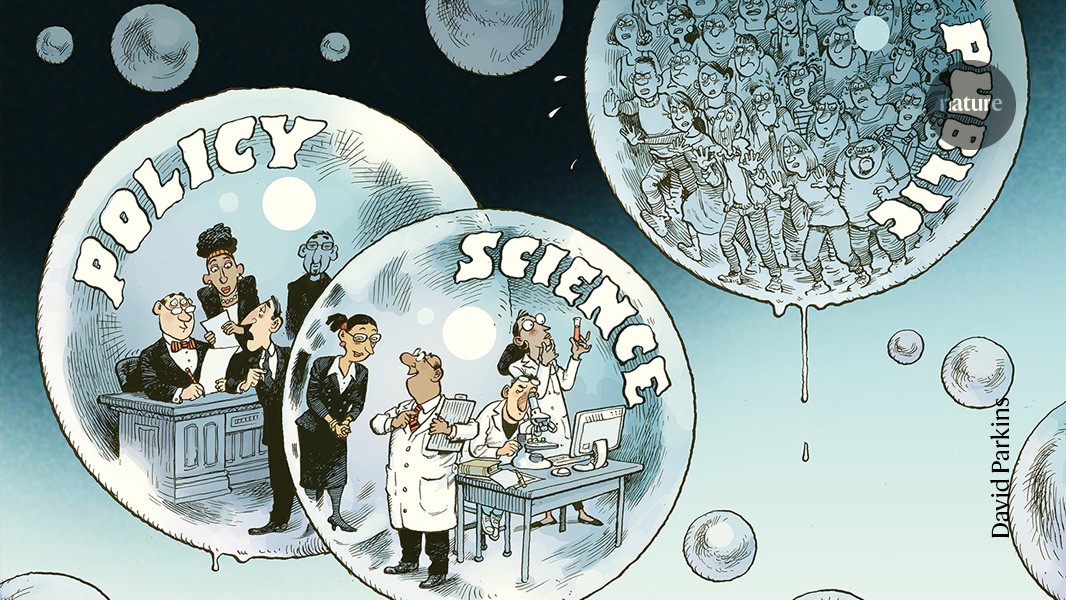
Six ways to put the public at the heart of science and policy
- Chris Tyler
Chris Tyler is an associate professor at University College London, UK.
Search author on: PubMed Google Scholar
- K. L. Akerlof
K. L. Akerlof is an associate professor at George Mason University, Fairfax, USA.
Search author on: [PubMed](http://www.ncbi.nlm.nih.gov/entrez/query.fcgi?cmd=search&term=K. L.+Akerlof) Google Scholar
- Musa al-Gharbi
Musa al-Gharbi is an assistant professor at Stony Brook University, New York, USA.
Search author on: PubMed Google Scholar
- Bjørn Bedsted
Bjørn Bedsted is international director at Democracy x, Copenhagen, Denmark.
Search author on: PubMed Google Scholar
- Laura Boeira
Laura Boeira is head of partnerships and networks at Instituto Veredas, São Paulo, Brazil.
Search author on: PubMed Google Scholar
- Tracey Brown
Tracey Brown is director of Sense About Science, London, UK.
Search author on: PubMed Google Scholar
- Elizabeth Christopherson
Elizabeth Christopherson is president and chief executive of the Rita Allen Foundation, Princeton, New Jersey, USA.
Search author on: PubMed Google Scholar
- Dietram A. Scheufele
Dietram A. Scheufele is a principal investigator at the Morgridge Institute for Research, Madison, Wisconsin, USA.
Search author on: [PubMed](http://www.ncbi.nlm.nih.gov/entrez/query.fcgi?cmd=search&term=Dietram A.+Scheufele) Google Scholar
- Mahmud Farooque
Mahmud Farooque is associate director of the ASU Consortium for Science, Policy and Outcomes, Washington DC, USA.
Search author on: PubMed Google Scholar
- Brian W. Head
Brian W. Head is a professor at the University of Queensland, Brisbane, Australia.
Search author on: [PubMed](http://www.ncbi.nlm.nih.gov/entrez/query.fcgi?cmd=search&term=Brian W.+Head) Google Scholar
- Tepring Piquado
Tepring Piquado is president at ADDSTEAM, Bellflower, California, USA.
Search author on: PubMed Google Scholar
- David Budtz Pedersen
David Budtz Pedersen is a professor at Aalborg University, Copenhagen, Denmark.
Search author on: [PubMed](http://www.ncbi.nlm.nih.gov/entrez/query.fcgi?cmd=search&term=David Budtz+Pedersen) Google Scholar
- [Bluesky](https://bsky.app/intent/compose?text=Six+ways+to+put+the+public+at+the+heart+of+science+and+policy https%3A%2F%2Fwww.nature.com%2Farticles%2Fd41586-026-01981-z)
- [Whatsapp](https://wa.me/?text=Six+ways+to+put+the+public+at+the+heart+of+science+and+policy https%3A%2F%2Fwww.nature.com%2Farticles%2Fd41586-026-01981-z)
- X
Many pressing issues facing society relate to science and technology: from artificial intelligence and pandemic preparedness to the transition to clean energy. Governments, advised by scientists, will decide how countries respond. Yet, the public is rarely consulted on decisions that shape many people’s lives.
Have people stopped trusting science? The data tell a surprising story
Democratizing research and science-policy processes will mean rethinking how scientists, citizens and policymakers interact. Here, we highlight six steps that governments and academic institutions can take to put the public at the heart of their work, reflecting outcomes of a workshop in Fairfax, Virginia, in September 2025. (Other attendees at the workshop, who contributed to this article, are listed as co-signatories in the supplementary information).
Involve the public in research
Public involvement can also make technical evidence more readily interpretable and thus potentially more trustworthy. In 2016, for instance, UK researchers and the London-based charity Sense About Science worked with parents to co-design a website that explained in simple terms why hospitals cannot be easily compared with one another when it comes to survival rates for congenital heart surgery. This helped to overcome previous misinterpretations and alarm around the publication of crude league tables.
The complex truth about trust in science
Yet few funders require participatory research as a condition of grants. Most promotion criteria do not reward it. And few universities maintain dedicated community-liaison staff or citizen panels. It’s easy to understand why — this work is difficult, slow and expensive. It requires sustained relationship building and repeated rounds of consultation with citizens. It also demands skills that most researchers are not trained in, such as navigating power imbalances that arise when community members lack technical vocabulary.
To move forwards, universities should establish units that provide methodological support, relationship building and logistics for participatory projects. Funders should make public involvement an expected part of research proposals and projects, from setting the agenda to disseminating the outcomes, and they should properly finance it. Not every project needs participatory methods, but public involvement should be the default expectation, with reasons given when it is not included.
Make advisory bodies participatory
Governments should also build community participation into science advisory committees. Public deliberation should be included early, rather than being at the end or ignored entirely, as it often is currently.
This can be achieved in several ways. Citizen panels suit complex and value-laden questions. Consensus conferences (in which randomly selected citizens deliberate over days and produce recommendations) can help to define the problems that science and government should prioritize. Online consultations with citizens offer broad reach, although usually with weaker deliberative quality.
Citizen panels can help to shape a government’s legislative priorities. Credit: Horacio Villalobos/Corbis via Getty
In each case, citizens clarified the values that should guide policy. All governmental science-advisory bodies should define these values early to ensure that advice is socially grounded, legitimate and more likely to shape decisions.
Embrace diverse knowledge
Communities outside academia and government also have valuable knowledge. Trust is built when people recognize that their expertise has been taken seriously. Researchers, science advisers and policymakers should empower people to voice their questions, values and concerns — and not dismiss ones that they disagree with.
Many countries are working to incorporate broader forms of expertise into policy — particularly Indigenous knowledge. The lessons emerging are consistent: formal institutional channels, such as legal frameworks and mandated co-governance bodies, are needed for lasting change; goodwill is not enough. Knowledge holders need genuine decision-making power, and bridging diverse knowledge systems requires skilled cultural intermediaries.
Community knowledge has improved mangrove restoration in the Philippines. Credit: Ezra Acayan/Getty
Universities should set requirements to make inclusive knowledge practices the norm, rather than the exception. They should change their promotion criteria to recognize co-produced research. And grant funders should require co-production plans for projects, with community partners listed as co-investigators. The University of Victoria in Canada is a good example: it insists that research involving Indigenous groups must follow protocols defined by those communities to ensure that they own and control the data.
Be humble, honest and transparent
Transparency is crucial in cases in which policymaking is urgent and tough choices need to be made quickly. Without it, narratives about back-room science can flourish.
For example, during the COVID-19 pandemic, trust in the UK government’s science-advisory group for emergencies was damaged by its initial opacity — it did not initially publish the minutes of meetings, for instance. By contrast, the UK Joint Committee on Vaccination and Immunisation routinely published its minutes and the reasoning behind contested recommendations, such as why it did not initially recommend universal COVID-19 vaccinations for healthy 12–15-year-olds. This transparency did not resolve every disagreement, but it gave journalists, clinicians and the public a visible trail of reasoning to scrutinize.
Scientists should recognize their own political biases to build public trust
Similarly, scientists should be open about their methods, data and uncertainties, including when advising informally. And they should acknowledge the values that shape their recommendations — a rare occurrence in current science advice. This might mean stating that they prioritize precautionary approaches to safety over reducing regulation; or value individual liberty over collective-risk reduction.
Finding common ground can be powerful. Everyone holds identities beyond their professional ones — as members of faith communities, cultural groups and local neighbourhoods. For example, Christian organization BioLogos in Grand Rapids, Michigan, promotes both faith and science as a way to engage Christian audiences on evolution, vaccination and climate change.
Similarly, the non-profit organization Ciencia Puerto Rico in San Juan shows how culturally grounded engagement can reach communities that top-down messaging cannot. The organization co-designs public-health campaigns with local community organizations and health-care workers, presented in everyday language and distributed through a community-ambassador programme that supports trusted local leaders.
Enjoying our latest content?
Log in or create an account to continue
- Access the most recent journalism from Nature's award-winning team
- Explore the latest features & opinion covering groundbreaking research
doi: https://doi.org/10.1038/d41586-026-01981-z
References
- Organisation for Economic Co-operation and Development. Innovative Citizen Participation and New Democratic Institutions (OECD, 2020). Google Scholar
- Chilvers, J. & Kearnes, M. Sci. Technol. Human Values 45, 347–380 (2020). Article
- Maia Loureiro, P. & Horta, H. Sci. Public Policy 51, 721–733 (2024). Article
- Heney, V. & Poleykett, B. Sociol. Health Illn. 44, 179–194 (2022). Article
- Agyei-Manu, E. et al. Health Expect. 26, 1436–1452 (2023). Article
- Valgarðsson, V. et al. Br. J. Polit. Sci. 55, e15 (2025). Article
- Mede, N. G. & Schäfer, M. S. Public Understand. Sci. 29, 473–491 (2020). Article
- Cacari-Stone, L., Wallerstein, N., Garcia, A. P. & Minkler, M. Am. J. Public Health 104, 1615–1623 (2014). Article
- Rosa, A., Gudowsky, N. & Warnke, P. Eur. J. Futures Res. 6, 14 (2018). Article
- Bednarek, A. T. et al. Proc. Natl Acad. Sci. USA 122, e2400931121 (2025). Article
- Joss, S. Sci. Public Policy 25, 2–22 (1998). Article
- Farooque, M. & Kessler, J. L. Issues Science Technol. 39, 74–80 (2023). Google Scholar
- Marquez, G. P. B. & Olavides, R. D. Disasters 48, e12630 (2024). Article
- Langbein, J. H. Univ. Chicago Law Rev. 52, 823–866 (1985). Article
- Iordanou, K., Antoniou, A. & De Vos, M. J. Acad. Ethics 24, 56 (2026). Article
Supplementary Information
Competing Interests
The authors declare no competing interests.
Related Articles
- Have people stopped trusting science? The data tell a surprising story
- The complex truth about trust in science
- Scientists should recognize their own political biases to build public trust
- How FAIR data are helping to build trust in science
- Why science has a credibility problem — and how to address it
- Why we don’t really know what the public thinks about science
- Science’s big problem is a loss of influence, not a loss of trust
- How to get science back into policymaking
Subjects
Latest on
- [Listen to Gen Z when it comes to AI in education
Correspondence 07 JUL 26](https://www.nature.com/articles/d41586-026-02110-6)
- [AI can cause harm: safeguards must catch up
Correspondence 07 JUL 26](https://www.nature.com/articles/d41586-026-02109-z)
- [Save Hubble: the race to preserve the space telescope kicks off
World View 07 JUL 26](https://www.nature.com/articles/d41586-026-02000-x)
- [China boosts prestigious grants for young scientists — will it ease competition?
News 03 JUL 26](https://www.nature.com/articles/d41586-026-01989-5)
- [Cancer Research UK bets on Manchester with £6-million funding boost
Career News 01 JUL 26](https://www.nature.com/articles/d41586-026-02019-0)
- [How one US scientist is adapting to life abroad after DOGE cuts
Career Q&A 29 JUN 26](https://www.nature.com/articles/d41586-026-01137-z)
- [How should I respond to race-based exclusion in my lab?
Career Feature 23 JUN 26](https://www.nature.com/articles/d41586-026-01130-6)
- [The future of science communication is not an article like this
Editorial 02 JUN 26](https://www.nature.com/articles/d41586-026-01723-1)
- [Poor supervision is pushing young researchers out of academia
News 01 JUN 26](https://www.nature.com/articles/d41586-026-01693-4)
Jobs
You will contribute to the success of the BMC Series by supporting editorial handling of content in BMC Sports Science, Medicine and Rehabilitation an New York City, New York (US) Springer Nature Ltd
AI and Data Science for Bioengineering | Translational Pediatric Bioengineering Barcelona (Localidad), Cataluña (ES) Institute for Bioengineering of Catalonia (IBEC)
The University invites individuals from diverse backgrounds to apply for faculty positions in this field Dongguan, Guangdong, China City University of Hong Kong (Dongguan)
The University invites individuals from diverse backgrounds to apply for faculty positions in this field Dongguan, Guangdong, China City University of Hong Kong (Dongguan)
The University invites individuals from diverse backgrounds to apply for faculty positions in this field Dongguan, Guangdong, China City University of Hong Kong (Dongguan)
Related Articles
- Have people stopped trusting science? The data tell a surprising story
- The complex truth about trust in science
- Scientists should recognize their own political biases to build public trust
- How FAIR data are helping to build trust in science
- Why science has a credibility problem — and how to address it
- Why we don’t really know what the public thinks about science
- Science’s big problem is a loss of influence, not a loss of trust
- How to get science back into policymaking
Subjects
Sign up to Nature Briefing
An essential round-up of science news, opinion and analysis, delivered to your inbox every weekday.