Brexit tore apart European science — now the research rifts are healing
- Elizabeth Gibney
View author publications Search author on: PubMed Google Scholar
- [Bluesky](https://bsky.app/intent/compose?text=Brexit+tore+apart+European+science+%E2%80%94+now+the+research+rifts+are+healing https%3A%2F%2Fwww.nature.com%2Farticles%2Fd41586-026-01841-w)
- [Whatsapp](https://wa.me/?text=Brexit+tore+apart+European+science+%E2%80%94+now+the+research+rifts+are+healing https%3A%2F%2Fwww.nature.com%2Farticles%2Fd41586-026-01841-w)
- X
UK Prime Minister Keir Starmer meets European Commission president Ursula von der Leyen. The United Kingdom and European Union will resume ‘reset talks’ in July. Credit: Benjamin Cremel/AFP/Getty
Ten years after the United Kingdom voted to leave the European Union, there are signs that their relationship in research is healing.
One big win came with an agreement in April: starting in 2027, the United Kingdom will rejoin Erasmus+, an EU exchange scheme used by PhD students and university staff. Another is the news that the UK share of funding from the EU’s flagship €95-billion (US$110-billion) Horizon Europe funding scheme has begun to recover after the country rejoined the programme in 2024.
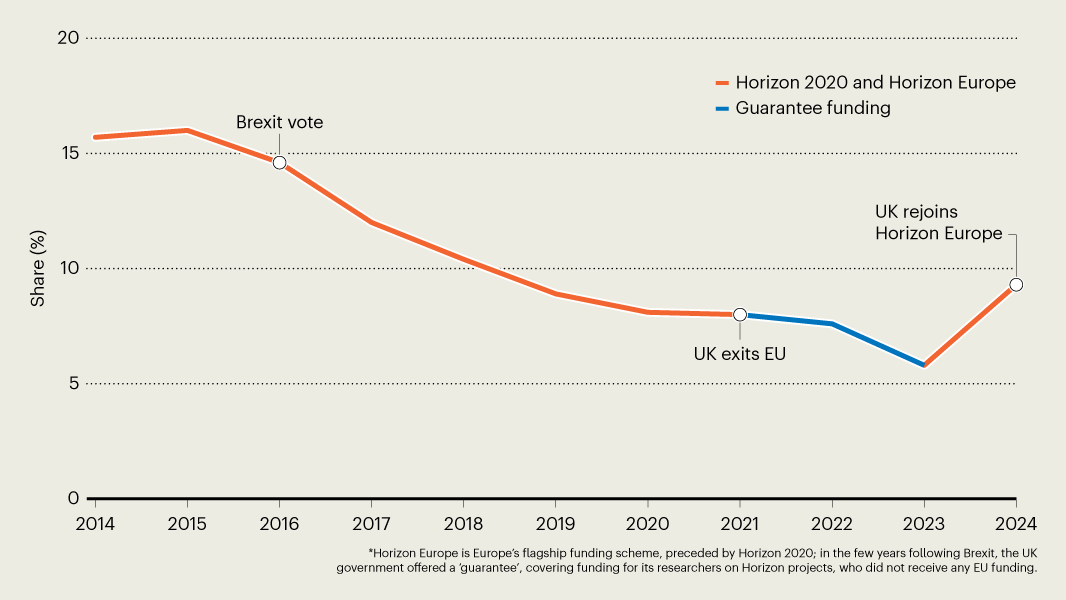
UK participation in EU research projects had tanked in the wilderness years between Brexit and the country’s reassociation with Horizon Europe, but has increased since 2024 (see ‘EU funding access’).
The political will to further rebuild UK–EU science relations is there, in part. The United Kingdom’s Labour government is slowly following through with its manifesto pledge to build a closer relationship with the EU. As part of ‘reset’ talks that began at a summit in May last year, the EU and United Kingdom hope eventually to reach deals on science-related issues, such as a mobility programme enabling young people to study and work across borders.
“The change of government, the [Labour] manifesto pledge to reset the relationship and then particularly the May summit last year really did put us on a new trajectory,” says Uta Staiger, a researcher in European studies at University College London and an adviser on Brexit to the institution’s leadership.
But the country has not yet resumed its pre-Brexit role as a cornerstone of European research, and further UK–EU reset talks, slated for next month, have stalled. The agenda has not yet been published, but a major sticking point and focus of talks is thought to be the structure of the youth mobility scheme.
“Funding is recovering,” says Vassiliki Papatsiba, who studies research and policy at Cardiff University, UK. But it will be harder to re-build the United Kingdom’s credibility and networks of research collaboration, she says. “The progress is promising, but I do not think that the same position will be recovered in the foreseeable future.”
Source: Statistics on UK Participation in EU Framework Programmes, 2014–2024
Funding uncertainty
UK–EU research relations are still recovering from the shock result of the Brexit referendum in June 2016, which had an immediate impact on research collaborations and applications to European funding programmes, even before the United Kingdom officially left the EU on 31 January 2020.
Many EU-based researchers were cautious about building funding proposals around UK partners when the country’s eventual relationship with the EU was unclear, says Papatsiba. “And uncertainty is risk.” Although replacement UK ‘guarantee’ government funding meant that researchers in the country could still take part in Horizon Europe calls, they could not lead collaborations.
The UK’s post-Brexit EU science deal: a graphical guide
But UK participation in EU research funding has begun to rebound since the country rejoined Horizon Europe — the share of EU grants awarded to UK scientists hit 9.3% in 2024. Although this is well below the pre-Brexit peak, data from the EU’s Horizon Dashboard (which is based on when agreements were signed, rather than calls announced) suggest that this upward trend will continue.
“Our time out in the desert has affected participation rates,” says Staiger. “It’s quite natural that it might take some time to bed back down.”
On the Horizon
Key to rebuilding European partnerships will be the United Kingdom’s role in the next iteration of Horizon Europe, from 2028 to 2034 — with a proposed budget of €175 billion, a hike of 50% in real terms. EU governments are still negotiating the programme’s form and final budget, and it is the first time the United Kingdom has no official voice or vote.
As an associate country, rather than a member, the United Kingdom’s ability to shape European research policy has diminished, says Dani Payne, who leads education-policy research at the Social Market Foundation, a think tank in London. The European Commission is also boosting funding for defence and dual-use research with both civilian and military applications. Collaborations with UK-based researchers could face more oversight, and the United Kingdom could be shut out of certain EU funding streams altogether because of regulations that allow participation only from EU countries.
Enjoying our latest content?
Log in or create an account to continue
- Access the most recent journalism from Nature's award-winning team
- Explore the latest features & opinion covering groundbreaking research
doi: https://doi.org/10.1038/d41586-026-01841-w
References
- Oldac, Y. & Olivos, F. High. Educ. https://doi.org/10.1007/s10734-025-01596-9 (2025). Article
Related Articles
- Europe can capture the US brain drain — if it acts fast
- Europe must become a research epicentre as US system gets undermined
- Five years on: how Brexit changed three scientists’ careers
- The EU’s Horizon research fund needs to stay a defence-free zone
- Will Europe ramp up defence research? War prompts major rethink
- The UK’s post-Brexit EU science deal: a graphical guide
- Horizon Europe turmoil changed the lives of these five scientists
- UK’s new science minister on budget battles, Brexit and AI leadership
Subjects
Latest on
- [Nepal’s new science ministry must strengthen scientific capacity
Correspondence 23 JUN 26](https://www.nature.com/articles/d41586-026-01970-2)
- [Do not leave fungi out of impact assessments
Correspondence 23 JUN 26](https://www.nature.com/articles/d41586-026-01972-0)
- [Silicon Valley’s vision for global AI is flawed: each country needs its own blueprint
World View 23 JUN 26](https://www.nature.com/articles/d41586-026-01951-5)
- [‘Us’ not ‘them’: scientists must use their skills to help stop polarization and division
Editorial 24 JUN 26](https://www.nature.com/articles/d41586-026-01952-4)
- [Europe as science superpower: what it will take to rival the US and China
News Feature 23 JUN 26](https://www.nature.com/articles/d41586-026-01955-1)
- [Europe must seize the moment to lead on free and open science
Editorial 23 JUN 26](https://www.nature.com/articles/d41586-026-01953-3)
- [Why science needs the humanities more than ever
Comment 24 JUN 26](https://www.nature.com/articles/d41586-026-01958-y)
- [‘Us’ not ‘them’: scientists must use their skills to help stop polarization and division
Editorial 24 JUN 26](https://www.nature.com/articles/d41586-026-01952-4)
- [Nepal’s new science ministry must strengthen scientific capacity
Correspondence 23 JUN 26](https://www.nature.com/articles/d41586-026-01970-2)
Jobs
If you are interested in developing and using cutting-edge concepts, join us in our ongoing research training group. Regensburg (Stadt), Bayern (DE) University of Regensburg (UR)
We invite applications from visionary, internationally recognised scientific leaders with strong management skills Budapest (HU) Hungarian Research Network
We invite applications from visionary, internationally recognised scientific leaders with strong management skills Sopron (HU) Hungarian Research Network
The HUN-REN Hungarian Research Network invites applications for the position of Director General of the HUN-REN Biological Research Centre Szeged (HU) Hungarian Research Network
Senior Scientist (all genders) at TU Wien Vienna (AT) Vienna University of Technology (TU Wien)
Related Articles
- Europe can capture the US brain drain — if it acts fast
- Europe must become a research epicentre as US system gets undermined
- Five years on: how Brexit changed three scientists’ careers
- The EU’s Horizon research fund needs to stay a defence-free zone
- Will Europe ramp up defence research? War prompts major rethink
- The UK’s post-Brexit EU science deal: a graphical guide
- Horizon Europe turmoil changed the lives of these five scientists
- UK’s new science minister on budget battles, Brexit and AI leadership
Subjects
Sign up to Nature Briefing
An essential round-up of science news, opinion and analysis, delivered to your inbox every weekday.